
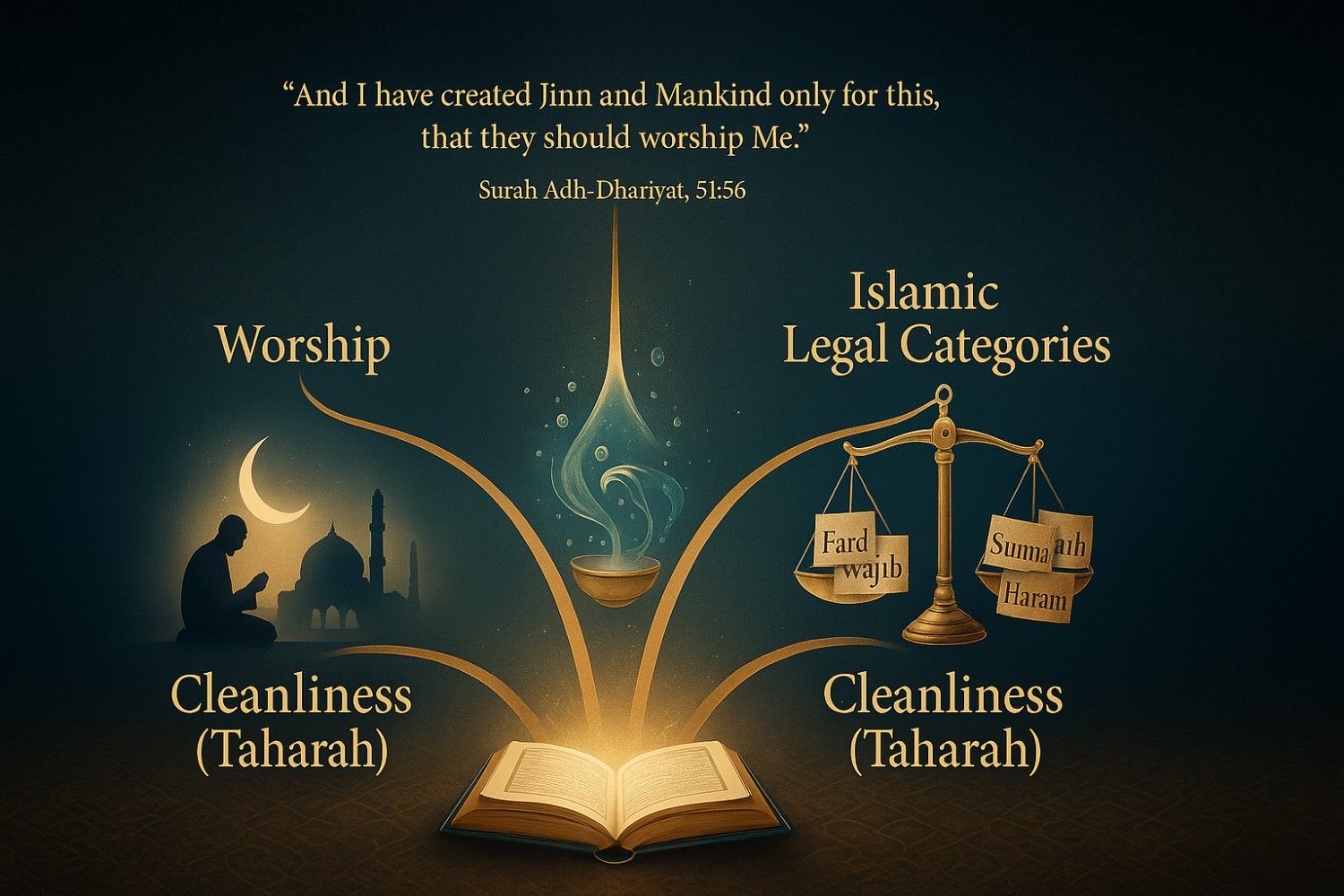
A Comprehensive Explanation of the purpose of human creation. Worship, Cleanliness, and Islamic Legal Categories
Divine Declaration of Purpose
Allah Almighty states:
“وَ مَا خَلَقْتُ الْجِنَّ وَ الْاِنْسَ اِلَّا لِيَعْبُدُوْنِ”
“And I have created Jinn and Mankind only for this, that they should worship Me.”
(Surah Adh-Dhariyat, 51:56)
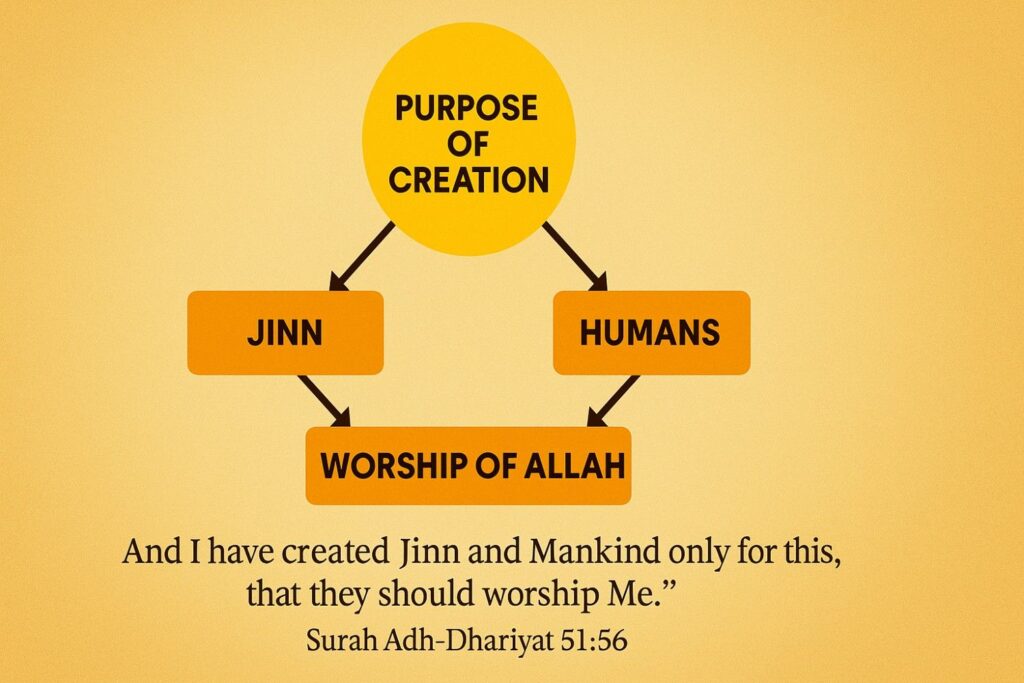
Even a person with a little intellect knows that anything created for a specific purpose is useless if it fails to fulfill that purpose. Therefore, a person who does not recognize his Creator and Sustainer, and does not worship Him, is human in name only — in reality, he is not a human but rather a worthless thing.
Thus, it becomes evident that worship is what makes a human truly human, and through it lies both worldly success and salvation in the Hereafter. Consequently, every person must know the types, pillars, conditions, and rulings of worship — because without knowledge, correct action is impossible. Hence, acquiring religious knowledge is obligatory.
Foundation of Worship: Faith (Iman)
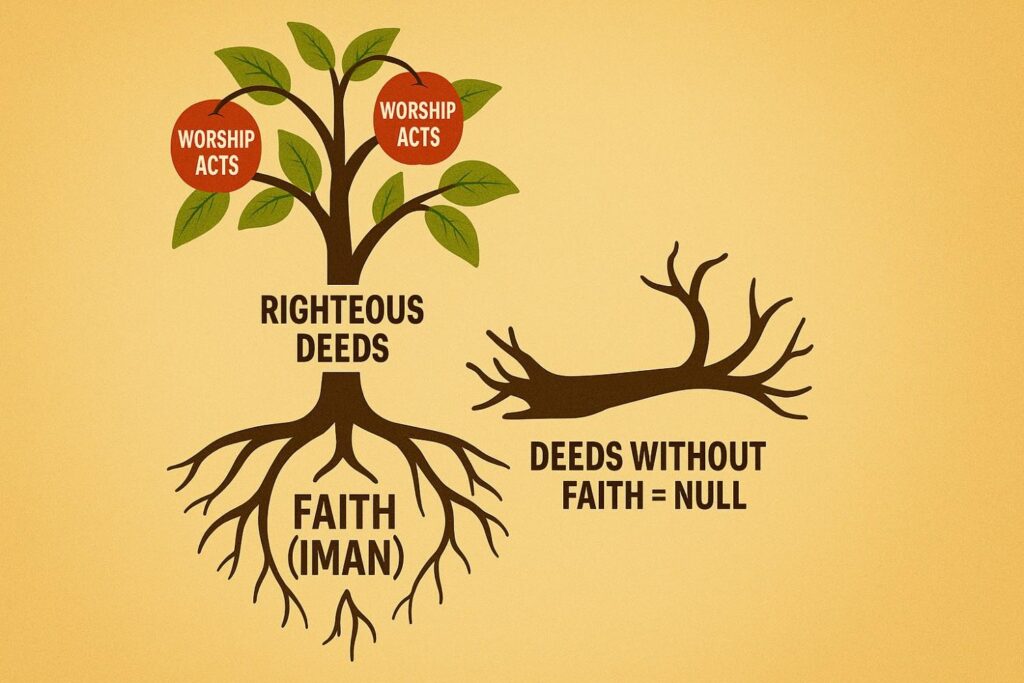
The foundation of all worship is faith. Without faith, worship is meaningless. Just as a tree bears fruit only when its roots are intact — once uprooted, it becomes fuel for fire — similarly, the worship of a disbeliever is rendered void, and he becomes the fuel of Hell.
Allah Almighty says:
وَ قَدِمْنَاۤ اِلٰى مَا عَمِلُوْا مِنْ عَمَلٍ فَجَعَلْنٰهُ هَبَآءً مَّنْثُوْرًا
“And whatever (apparent good) deeds they (disbelievers) have done, We have purposely made them scattered, floating particles of dust that are visible in the sunlight of the ventilator”
(Surah Al-Furqan, 25:23)
Types of Obligatory Worship upon a Believer
Once a person embraces Islam, two kinds of worship become obligatory upon him:
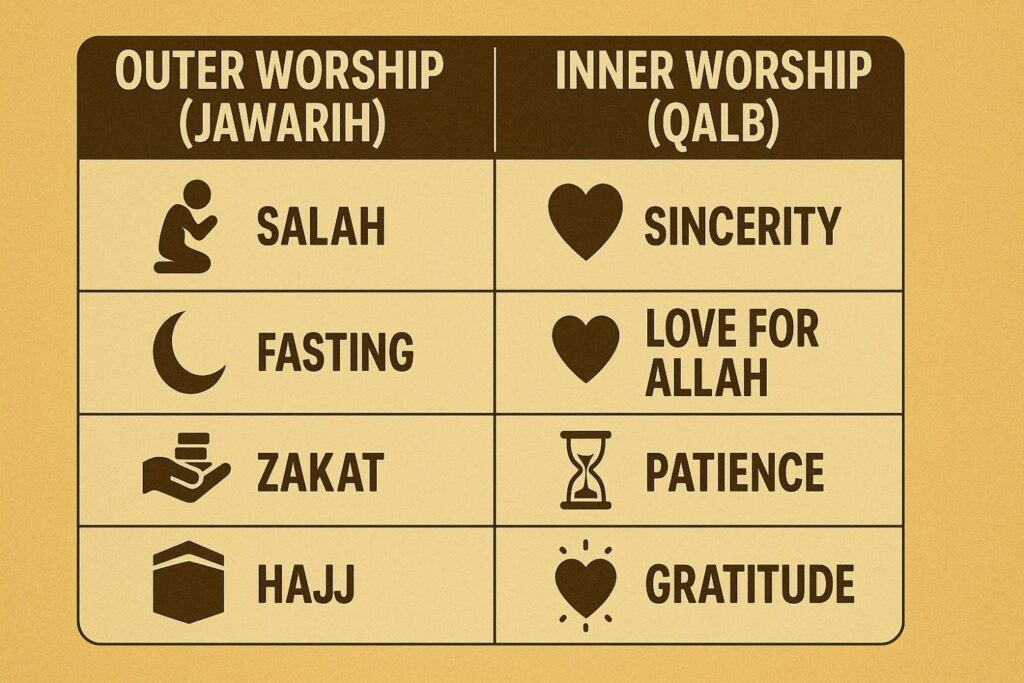
- Worship related to the physical limbs or outer body (Jawarih)
- Worship related to the heart or inner body (Qalb)
The second category — matters of the heart — is discussed in Ilm al-Suluk (the science of spiritual purification), while the first — outward or physical worship — is discussed in Fiqh (Islamic jurisprudence).
Divisions of Physical Worship
Physical worship is of two kinds:
- Those acts which concern the bond between the servant and Allah, such as the five daily prayers and fasting. These acts are purely for the sake of Allah and do not involve human interaction.
- Some of them are performed individually (such as five daily prayers and fasting).
- Some others require communal participation (like congregational prayers, Friday prayers, and Eid prayers); without it, these prayers can’t be performed.
- Those acts that aim to regulate and improve mutual human relations, such as marriage, trade, and other dealings.
The first kind is called “Ibadaat” (acts of worship), and the second “Muamalat” (transactions and social dealings).
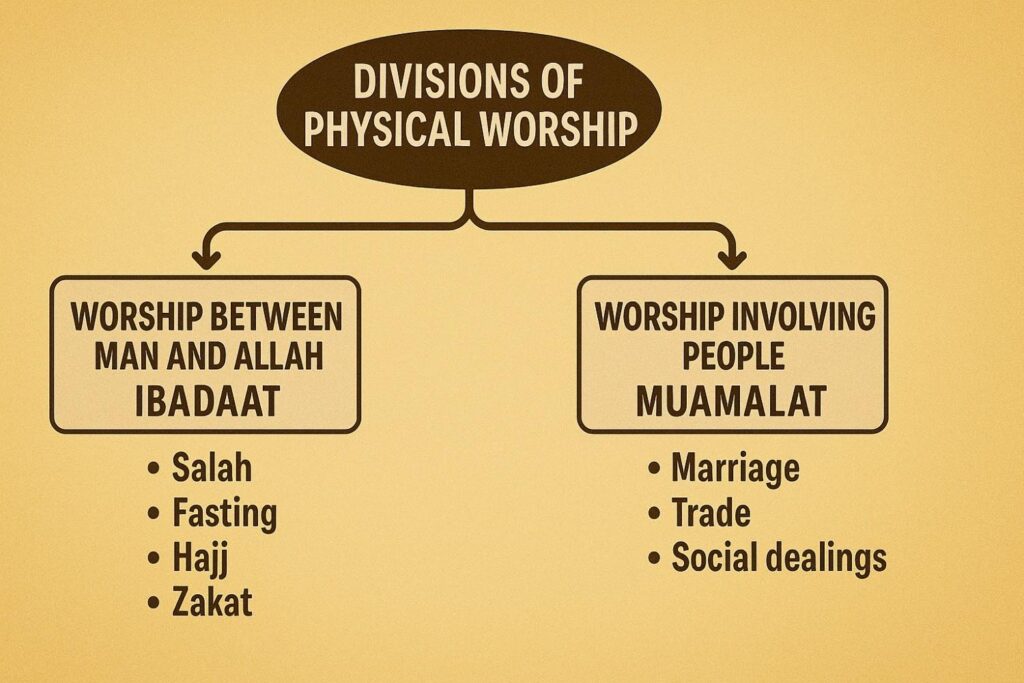
Even though the first type may not yield visible worldly benefits, and the second type may, rather, this aspect predominates: both are acts of worship and deserve rewards if performed in accordance with the commands of Allah and His Messenger ﷺ. Otherwise, they become sinful acts deserving punishment.
The Four Principal Acts of Worship
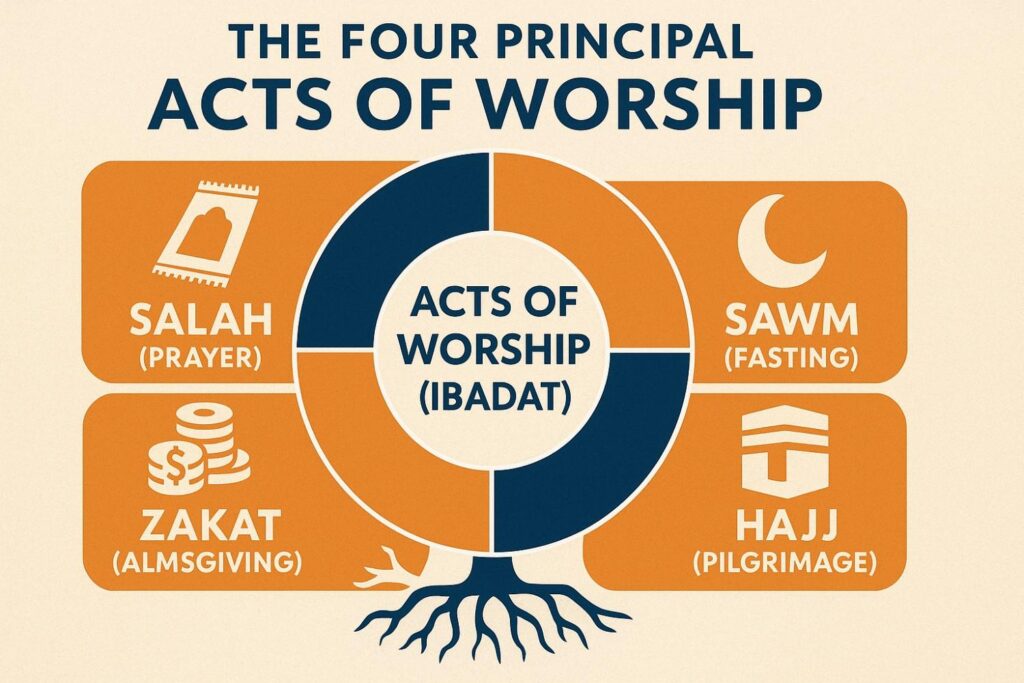
The acts of worship (Ibadaat) are four in number:
- Salah (Prayer)
- Sawm (Fasting)
- Hajj (Pilgrimage)
- Zakat (Almsgiving)
Among these, the most important and exalted is Salah (prayer), which is extremely beloved to Allah Almighty.
However, before performing Salah, the worshipper must attain purification or cleanliness (Taharah), as it is the key to prayer. Therefore, before explaining the rulings of Salah, the rulings of purification or cleanliness will be described, and after that, the rulings of Salah will be presented.
The Necessity and Significance of Purification (Taharah)
Purification is such an essential prerequisite for prayer that without it, prayer does not even exist. The scholars have stated that intentionally performing prayer without purification is an act of disbelief (kufr).
This is because such a person disrespects the sanctity of worship.
The Holy Prophet ﷺ said:
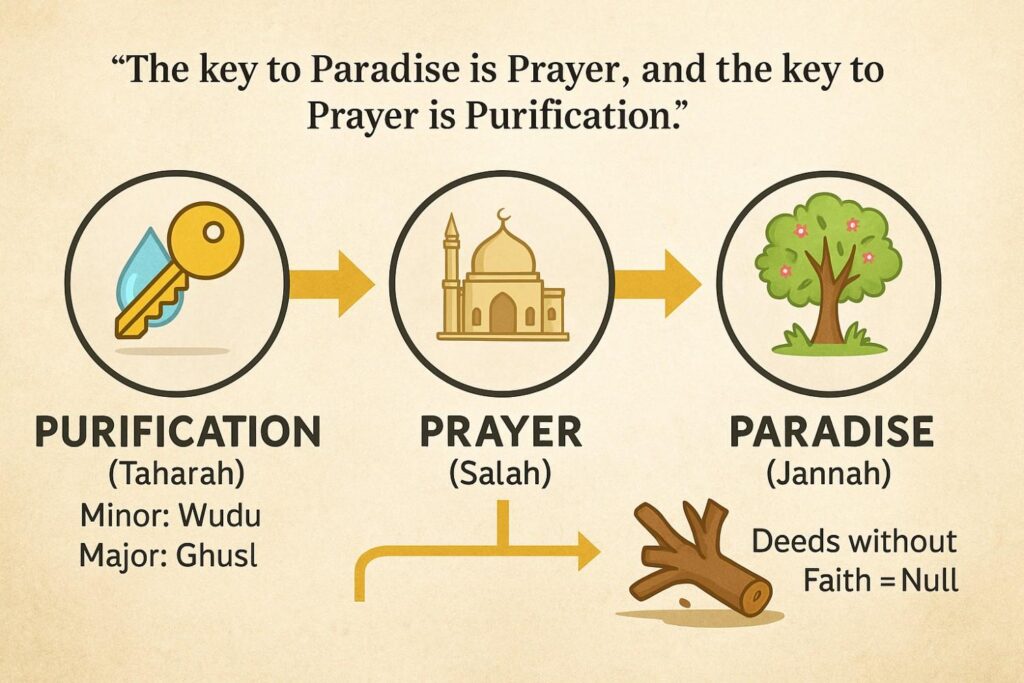
“The key to Paradise is prayer, and the key to prayer is purification.”
(Narrated by al-Nasa’i from Shabeeb ibn Abi Ruh)
Once, the Prophet ﷺ was reciting Surah Al-Rum in the morning prayer, and a recitational doubt arose. After the prayer, he said: What is the matter with those who pray with us but do not perfect their purification? It is because of them that doubt occurs in the recitation of the Imam.”
Hence, if incomplete purification brings such a severe consequence, how grave must be the calamity of praying without any purification at all!
The Prophet ﷺ also said:
“Purification is half of faith.” Narrated by al-Tirmidhi, a Hasan (sound) Hadith)
Purification is of two kinds:
- Minor Purity (Taharah Sughra) → Wudu (Ablution)
- Major Purity (Taharah Kubra) → Ghusl (Full Ritual Bath)
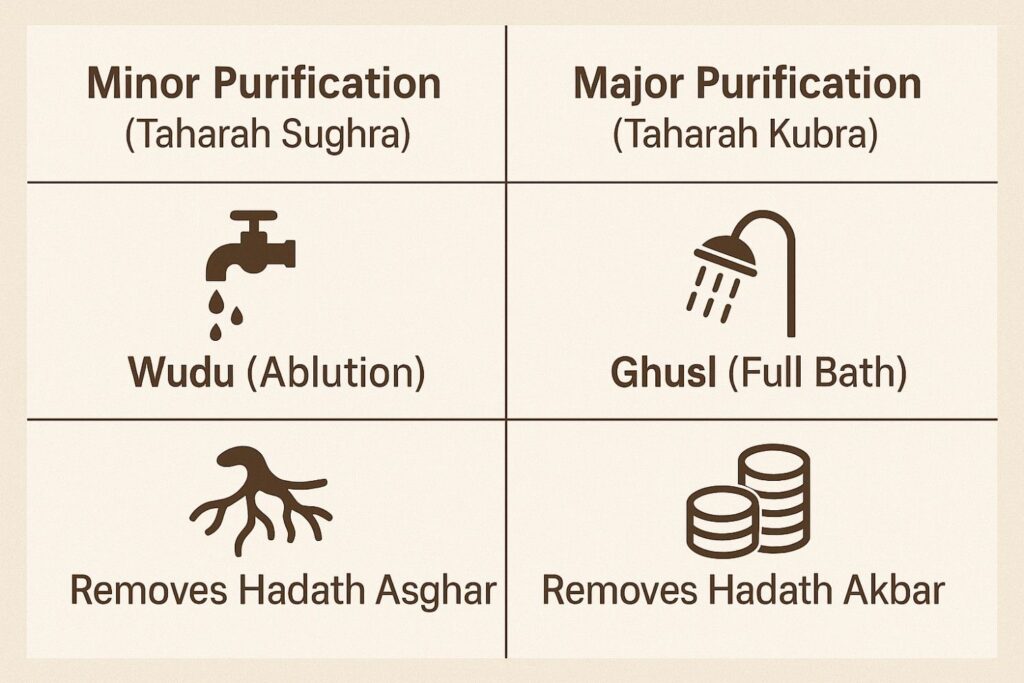
Impurities that require only Wudu are called Hadath Asghar (Minor Impurity), and those that necessitate Ghusl are Hadath Akbar (Major Impurity).
Important Technical Terms and Classifications
Certain essential jurisprudential terms must be understood, as they are used throughout Islamic rulings:
1. Fard I‘tiqadi (Obligatory or Fard by Creed)
Established by definitive evidence (Dalil Qat‘i, i.e., with such evidence that has no doubt in it). Denying it constitutes absolute disbelief (kufr) according to the Imams of Hanafi’s. If its obligation is universally known and someone denies it, consensus (Ijma‘) affirms his disbelief, such that one who doubts the disbelief of this denier is himself a disbeliever. Even missing it once without a valid excuse according to Shariah makes one sinful, a fasiq, and deserving of punishment, like missing the prayer, bowing, and prostration.
2. Fard ‘Amali (Obligatory by Action)
One whose proof may not be absolutely certain, but in the view of a Mujtahid (Islamic jurist), by the command of Shariah evidence, it is certain that without it a person will not be considered free from obligation; even if it is a duty (fard) within an act of worship, that worship without it will be invalid.
Denying it without proof is misguidance (fisq). Qualified scholars (mujtahids) may differ based on evidence — e.g.,
- According to the Hanafis, wiping (Masah of) one-fourth of the head in wudu is obligatory.
- According to the Shafi‘is, wiping (Masah of) one hair suffices.
- According to the Malikis, the entire head must be wiped (Masah).
- For Hanafis, reciting “Bismillah” and having intention in wudu are Sunnah; for Shafi‘is and Hanbalis, they are obligatory or Fard.
Each follower should adhere to their own Imam’s rulings and must not follow another Imam’s rulings without a valid Shariah necessity.
3. Wajib I‘tiqadi (Obligatory in belief)
That whose necessity is proven by probable evidence. The practical obligation (farḍ ‘amali) and the obligatory action (wājib ‘amali) are its two types, and they depend on these two.
4. Wajib ‘Amali (Essential by Practice)
Obligatory in practice: It is that obligatory in belief whose performance may be excused, but there is a strong likelihood of its necessity. If its fulfillment is required in any act of worship, then the worship remains deficient without it, but is still valid. A Mujtahid (Islamic jurist) may deny an obligatory act based on Shariah evidence. Deliberately abandoning a single obligatory act is a minor sin, and repeatedly neglecting it is a major sin.
5. Sunnah Mu’akkadah (Emphasized Sunnah)
That which the Noble Prophet ﷺ consistently performed, although for the sake of explanation of permissibility, he sometimes omitted it, or he emphasized its performance but did not completely block the way of omission. Its abandonment is blameworthy, and performing it is rewarded. Occasional neglect incurs reproach, and habitual neglect deserves punishment.
6. Sunnah Ghair Mu’akkadah (Non-emphasized Sunnah)
That which, in the view of Shariah, is desirable and its abandonment is disliked, but not to the extent that a threat of punishment is pronounced on it, regardless of whether the Noble Prophet ﷺ consistently practiced it or not. Performing it is rewarded, and not performing it, even if habitually done, is not blameworthy.
7. Mustahabb (Recommended Act)
That which is liked in the view of Shariah but its abandonment is not disliked; whether the Noble Prophet ﷺ himself performed it or encouraged it, or the learned scholars liked it even if it is not mentioned in the Hadith. Performing it earns a reward, and not performing it carries absolutely no consequence.
8. Mubāh (Permissible Act)
An act that carries neither reward nor punishment, whether done or left.
9. Haram Qat‘i (Absolutely Forbidden)
The opposite of Fard. Doing it deliberately is a major sin; avoiding it is obligatory and rewardable.
10. Makruh Tahrimi (Severely Disliked)
This is the opposite of wajib (obligatory). Performing it makes the act of worship deficient, and the doer is sinful, although the sin is less severe than that of haram acts. Repeated commission of such an act amounts to a major sin.
11. Isa’ah (Improper Act)
The opposite of Sunnah Mu’akkadah — doing it occasionally incurs reproach; habitual performance leads to punishment.
12. Makruh Tanzihi (Mildly Disliked)
An act disapproved by Shari‘ah but without any threat of punishment — the opposite of Sunnah Ghair Mu’akkadah.
13. Khilaf al-Awla (Less Preferred Act)
A permissible act, but avoiding it is better — the opposite of Mustahabb.
Frequently Asked Questions
What is the purpose of human creation according to the Qur’an?
Allah Almighty declares:
“وَ مَا خَلَقْتُ الْجِنَّ وَ الْاِنْسَ اِلَّا لِيَعْبُدُوْنِ”
“And I have created Jinn and Mankind only for this, that they should worship Me.”
(Surah Adh-Dhariyat, 51:56)
This verse defines the sole purpose of human existence — to worship Allah (‘ibadah). Life gains meaning only through fulfilling this divine purpose.What happens if a person neglects worship?
One who fails to recognize and worship his Creator (i.e., Allah Almighty) becomes purposeless and worthless. He may appear human but lacks true humanity because his creation’s goal remains unfulfilled.
Why is knowledge of worship essential?
Without knowledge of worship’s pillars, conditions, and rulings, correct performance is impossible. Hence, acquiring religious knowledge (Ilm) is an obligation (fard) for every Muslim.
Why is faith the foundation of all worship?
Faith is like the root of a tree — without it, no act of worship can bear fruit. Without Iman, even seemingly good deeds are void in the sight of Allah.
What does the Qur’an say about good deeds of disbelievers?
وَ قَدِمْنَاۤ اِلٰى مَا عَمِلُوْا مِنْ عَمَلٍ فَجَعَلْنٰهُ هَبَآءً مَّنْثُوْرًا
“And whatever (apparent good) deeds they (disbelievers) have done, We have purposely made them scattered, floating particles of dust that are visible in the sunlight of the ventilator”
(Surah Al-Furqan, 25:23)
This means that without faith, deeds have no weight in the Hereafter.What kinds of worship become obligatory upon a Muslim?
Two types:
Physical (outer body – Jawarih) – like prayer, fasting, pilgrimage, charity.
Spiritual (inner body – Qalb) – like sincerity, humility, trust in Allah, love, and fear of Him.What are the two main branches of outward worship?
Ibadaat (acts purely between man and Allah) — e.g., Salah, fasting.
Mu‘amalat (social and transactional dealings) — e.g., marriage, trade, contracts.Are social dealings like trade considered worship?
Yes, if done according to Shariah with sincere intention, they are acts of worship and rewardable.
What are the four principal acts of worship?
The four pricipal acts of worship are:
1. Salah (Prayer)
2. Sawm (Fasting)
3. Zakat (Almsgiving)
4. Hajj (Pilgrimage)Why is purification necessary before prayer?
Because the Prophet ﷺ said:
“The key to Paradise is prayer, and the key to prayer is purification.” (al-Nasa’i)
Without purification, prayer is invalid.What is the consequence of praying without purification?
Intentionally praying without purification is an act of disbelief (kufr), as it insults the sanctity of worship.
What are the two types of purification?
Minor purification (Taharah Sughra) – through Wudu (Ablution)
Major purification (Taharah Kubra) – through Ghusl (Full Ritual Bath)What is Hadath Asghar and Hadath Akbar?
Hadath Asghar → minor impurity requiring Wudu.
Hadath Akbar → major impurity requiring Ghusl.What is Fard I‘tiqadi (Obligatory by Creed)?
A duty established by definitive proof (Dalil Qat‘i). Denying it is disbelief (kufr). Example: belief in prayer, fasting, Zakat, and Hajj.
What is Fard ‘Amali (Obligatory by Action)?
An act proven obligatory by strong but not absolute evidence. Denying it is misguidance, not disbelief. Example: wiping part of the head during Wudu.
What is the difference between Fard and Wajib?
Fard: Denial = disbelief; omission = major sin, worship invalid.
Wajib: Denial = misguidance; omission = minor sin, worship valid but deficient.What is Wajib I‘tiqadi and Wajib ‘Amali?
Wajib I‘tiqadi: Proven by probable evidence but still necessary in belief.
Wajib ‘Amali: Obligatory in practice but omission is excusable; worship remains valid yet imperfect.What is Sunnah Mu’akkadah (Emphasized Sunnah)?
Acts the Prophet ﷺ regularly performed, rarely omitted, and strongly encouraged.
Example: Sunnah prayers before Fajr.
Neglecting them habitually is blameworthy and punishable.What is Sunnah Ghair Mu’akkadah (Non-emphasized Sunnah)?
Acts encouraged but not to the extent of threat of punishment, regardless of whether this act is consistently practiced by the Prophet ﷺ or not.
Example: Four rak‘ahs before Asr.
Omission is not sinful but disliked.What is Mustahabb (Recommended Act)?
Acts loved by Shariah — doing them earns reward, neglecting them has no punishment.
Example: Using siwak before prayer in wudu.What is Mubāh (Permissible Act)?
Actions neutral in Shariah — neither rewarded nor punished.
Example: Eating lawful food, sleeping, walking.What is Haram Qat‘i (Absolutely Forbidden)?
The opposite of Fard. Doing it is a major sin, avoiding it is obligatory.
Example: Drinking alcohol, adultery.What is Makruh Tahrimi (Severely Disliked)?
Opposite of Wajib. Doing it is sinful, though less severe than Haram.
Example: Leaving out Wājib acts in prayer.What is Isa’ah (Improper Act)?
The opposite of Sunnah Mu’akkadah — performing it occasionally leads to reproach; habitual performance to punishment.
What is Makruh Tanzihi (Mildly Disliked)?
Acts disapproved but without threat of punishment.
Example: Eating garlic before going to the mosque.What is Khilaf al-Awla (Less Preferred Act)?
A permissible act, but avoiding it is better.
Example: Performing optional (nafl) prayer while sitting without excuse.Why do scholars differ in rulings like Wudu or Salah?
Because evidence (dalil) may be interpreted differently by jurists (Mujtahids).
Example:
Hanafis: Wiping ¼ of head in Wudu is obligatory.
Shafi‘is: One hair suffices.
Malikis: Entire head must be wiped.Can a person follow different rulings from various Imams?
A follower must adhere to one Imam’s rulings unless a valid necessity in Shariah allows otherwise.
What is the link between purification and spiritual excellence?
Physical cleanliness reflects inner purity. Without inner sincerity, even outward acts lose value; hence, both Taharah (cleanliness) and Ikhlas (sincerity) are pillars of accepted worship.
How does understanding legal categories help a believer?
It brings balance — knowing what is essential, optional, disliked, or prohibited enables the believer to live consciously within divine boundaries and attain Allah’s pleasure.
I’ve shared some key foundational beliefs in Islam, with more insights coming soon. Stay connected to deepen your understanding and strengthen your faith. Missed our last post? Click the link here: Sainthood or Wilayah in Islam
If you come across any mistakes or have any questions, don’t hesitate to reach out. Insha’Allah, your effort will be rewarded by Allah Almighty. Stay connected with us through our social media handles below: